Login to cooktime24 in order to save your favorite recipes
If you have not registered yet, register now!

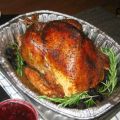
1 (14 -16 lb) frozen young whole turkey 1 Combine all brine ingredients, except ice water, in a stockpot, and bring to a boil. Stir to dissolve solids, then remove from heat, cool to room temperature, and refrigerate until thoroughly chilled. 2 Early on the day of cooking, (or late the night before) combine the brine and ice water in a clean 5-gallon bucket or 20-quart stock pot. (If you make the brine the same day you need to use it, just use a 7 lb bag of ice and 2 cups of cold water to chill it down fast.). 3 Place thawed turkey breast side down in brine, cover, and refrigerate or set in cool area (like a basement) for 6 hours. Turn turkey over once, half way through brining. If not refrigerated, add a couple pounds more ice halfway through to keep it good and cold. 4 A few minutes before roasting, heat oven to 500 degrees. Combine the apple, onion, cinnamon stick, and cup of water in a microwave safe dish and microwave on high for 5 minutes. 5 Remove bird from brine and rinse inside and out with cold water. Discard brine. 6 Place bird on roasting rack inside wide, low pan and pat dry with paper towels. Add steeped aromatics to cavity along with rosemary, sage, oregano, lemon and orange. Tuck wings under breasts and coat whole bird liberally with canola (or other neutral) oil. 7 Roast on lowest level of the oven at 500 degrees F. for 30 minutes. Remove from oven, pour in 3 cups of broth and scrape up any fond (browned bits) on the bottom of the pan. Cover breast with double layer of aluminum foil, insert probe thermometer into thickest part of the breast and return to oven, reducing temperature to 350 degrees F. After 45 minutes, add 1 more cup of broth. Set thermometer alarm (if available) to 161 degrees. A 14 to 16 pound bird should require a total of 2 to 2 1/2 hours of roasting. Let turkey rest, loosely covered for 15-30 minutes before carving. 8 For the gravy, strain the turkey pan juices from the roasting pan through a sieve and into a 4-cup glass measuring cup; discard the solids. Spoon off the fat from atop the pan juices. Add enough chicken broth, about 1 to 2 cups, to the pan juices to measure 4 cups total. Melt the butter in a heavy large saucepan over medium-high heat. Add the flour and whisk for 1 minute. Gradually whisk in the broth. Simmer until the gravy thickens slightly, whisking often, about 10 minutes. Season with salt and pepper. Serve the turkey with the gravy.
Source: food.com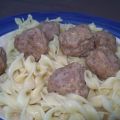
2 slices fresh white bread 1/4 cup milk 3 tablespoons clarified butter, divided 1/2 cup finely chopped onion 1 pinch plus 1 teaspoon kosher salt 3/4 lb ground chuck 3/4 lb ground pork 2 large egg yolks 1/2 teaspoon black pepper 1/4 teaspoon ground allspice 1/4 teaspoon freshly grated nutmeg 1/4 cup all-purpose flour 3 cups beef broth 1/4 cup heavy cream 1 Preheat oven to 200 degrees F. 2 Tear the bread into pieces and place in a small mixing bowl along with the milk. Set aside. 3 In a 12-inch straight sided saute pan over medium heat, melt 1 tablespoon of the butter. Add the onion and a pinch of salt and sweat until the onions are soft. Remove from the heat and set aside. 4 In the bowl of a stand mixer, combine the bread and milk mixture, ground chuck, pork, egg yolks, 1 teaspoon of kosher salt, black pepper, allspice, nutmeg, and onions. Beat on medium speed for 1 to 2 minutes. 5 Using a scale, weigh meatballs into 1-ounce portions and place on a sheet pan. Using your hands, shape the meatballs into rounds. 6 Heat the remaining butter in the saute pan over medium-low heat, or in an electric skillet set to 250 degrees F. Add the meatballs and saute until golden brown on all sides, about 7 to 10 minutes. Remove the meatballs to an ovenproof dish using a slotted spoon and place in the warmed oven. 7 Once all of the meatballs are cooked, decrease the heat to low and add the flour to the pan or skillet. Whisk until lightly browned, approximately 1 to 2 minutes. Gradually add the beef stock and whisk until sauce begins to thicken. Add the cream and continue to cook until the gravy reaches the desired consistency. Remove the meatballs from the oven, cover with the gravy and serve.
Source: food.com
8 ounces Italian bread, day old, approx 1/2 a standard loaf 3 garlic cloves , mashed 1/2 teaspoon kosher salt 8 tablespoons extra virgin olive oil , divided 2 large eggs 2 heads romaine lettuce hearts fresh ground black pepper , 7 grinds 1/2 small lemon , juiced 1/2 teaspoon Worcestershire sauce 4 ounces parmesan cheese , freshly grated 1 Heat oven to 350 degrees. 2 Cut the bread into 3/4-inch cubes and spread on a half sheet pan. Bake until thoroughly dry but not brown, 10-12 minutes. Set aside. 3 Bring 2 cups water to a boil in a 2-quart sauce pan. 4 Meanwhile, place the garlic and 1/2 teaspoon of the salt in a mortar and mash with the pestle to make a paste. Add 4 tablespoons of the oil to the paste and mash to combine. Pour the oil through a fine-mesh sieve into a 12-inch sautee pan. Place the pan over medium heat. Add the croutons and saute, tossing constantly until all of the oil is absorbed by the bread and the croutons turn gold, approximately 5 minutes. Set aside. 5 Add the eggs to the boiling water and cook for 1 minute. Immediately transfer to an ice-water bath to stop the cooking. Set aside. 6 In a very large bowl, tear the lettuce and toss, using tongs, with 2 tablespoons of the oil. 7 Sprinkle with the remaining pinch of salt and the pepper. Add the remaining 2 tablespoons olive oil. Toss well. 8 Add the lemon juice and worcestershire sauce, and break in the eggs. Toss until a creamy dressing forms. Toss in the parmesan cheese and serve topped with croutons.
Source: food.com
32 raw tail-on shrimp (21 to 25 count size) 1/4 cup kosher salt 1/4 cup sugar 1 cup water 2 cups ice 1 (14 1/2 ounce) can diced tomatoes , drained 1/2 cup prepared chili sauce 4 tablespoons prepared horseradish 1 teaspoon sugar 3 grinds fresh black pepper 1/2 teaspoon kosher salt 1 tablespoon olive oil 1 dash Old Bay Seasoning 1 Place cleaned shrimp into a bowl with brine and refrigerate mixture for 20 to 25 minutes. While shrimp are brining, place tomatoes, chili sauce, horseradish, sugar, pepper, and salt in food processor and blend until smooth. Refrigerate cocktail sauce until ready to serve. 2 Place a baking sheet or broiler pan under oven broiler and preheat for 5 minutes. Rinse the shrimp under cold water and dry on paper towels. In a large bowl, toss shrimp with olive oil and sprinkle with Old Bay seasoning, if desired. 3 Place shrimp onto a sizzling sheet pan and return to broiler immediately. After 2 minutes, turn the shrimp with a pair of tongs. Return the shrimp to broiler for 1 minute. Transfer to a cold cookie sheet. Refrigerate immediately.
Source: food.com
1 lb Tomato 9 cups low sodium chicken broth 3 cups short-grain rice 20 saffron strands 2 sprigs rosemary , leaves stripped from sprigs 3 teaspoons kosher salt , divided 1 teaspoon smoked paprika 2 tablespoons olive oil 3 lbs chicken quarters 1/2 lb fresh green beans , trimmed and halved 1 cup red bell pepper , chopped 1/2 cup green bell pepper , chopped 2 garlic cloves , minced 1 Spritz 4 to 5 pieces of newspaper with vegetable oil and put in the bottom of a charcoal chimney starter. Fill the chimney with half of the charcoal and light the newspaper. 2 When the charcoal is lightly covered with gray ash, carefully pour onto the bottom grate of a kettle grill and spread evenly. Top with the remaining unlit charcoal, spreading evenly so as not to suffocate the lit charcoal. Set the second grate in the kettle and cover until ready to cook. 3 Meanwhile, halve the tomatoes and remove the seeds to a fine mesh strainer set over a small bowl to catch the juice. Grate the seeded halves on the large hole side of a box grater and discard the skins. Combine the reserved juice and grated tomato and set aside. 4 Warm the chicken broth in a kettle or 4-quart saucepan over high heat until it reaches 200 degrees F. Remove the broth from the heat and cover to keep warm. 5 Combine the rice, saffron, rosemary, 1 teaspoon of the salt, and paprika in a small mixing bowl. 6 Heat the olive oil in the paella pan on the prepared grill. Season the chicken on all sides with the remaining 2 teaspoons of salt. Once the olive oil shimmers, add the chicken and cook until golden brown on both sides, approximately 5 to 6 minutes per side. Move the chicken to the outer edges of the pan. Add the green beans, red bell pepper, green bell pepper and garlic to the center of the pan and cook until they begin to soften and darken in color, approximately 2 to 3 minutes. Add the tomatoes and their juice and cook until most of the liquid has dissipated and the tomatoes thicken and darken, approximately 4 to 5 minutes. 7 Add the rice mixture to the center of the pan and cook, stirring constantly for 1 minute. 8 Redistribute the chicken pieces on top of the rice. Add 4 cups of the warm chicken broth and stir to distribute the rice evenly in the pan, making sure that all rice is completely submerged in liquid. From this point forward do not stir the paella. 9 After 8 to 9 minutes, when all of the liquid is absorbed and the rice appears dry, add an additional 4 cups of broth. Continue to cook without stirring, until the liquid is absorbed, about 8 to 9 minutes. The rice should be firm to the bite and the grains have a tiny white dot in the center. Add the remaining cup of broth as needed, until the rice is cooked through. Watch the fire to make sure it is heating evenly and adjust the pan to prevent uneven cooking. 10 Remove the pan from the heat, cover with a tea towel and rest for 15 minutes before serving.
Source: food.com
1/3 cup canola oil , plus 2 teaspoons canola oil , for sheet pan 3 lbs salmon , pin bones removed (1 side) 1 1/2 teaspoons kosher salt 1 teaspoon fresh ground black pepper 1 tablespoon whole coriander seed , toasted 1 tablespoon whole fennel seed , toasted 1 teaspoon whole cumin seed , toasted 1 star anise , pod 2 teaspoons onion powder 1 teaspoon garlic powder 1/2 teaspoon cayenne pepper 1 Rub sheet pan with the 2 teaspoons of oil and place side of salmon in pan. Salt and pepper salmon. Set aside. 2 Add coriander, fennel seed, cumin seed, star anise, onion powder, garlic powder and cayenne pepper to a blender. Turn blender on high and process until whole spices become powder. With blender running, pour in 1/3 cup canola oil and blend until well combined. Stop blender to brush down sides of container, if necessary. 3 Brush salmon with spice mixture. Allow salmon to sit at room temperature for 30 minutes. 4 Preheat oven to the high broiler setting. Place salmon in the oven 6-inches from broiler. Cook until salmon reaches an internal temperature of 131 degrees F. This will take approximately 15 minutes, but will vary with different ovens. Remove from oven and let rest for 10 minutes, and then serve immediately. Note that the internal temperature of the fish will a rise a little as carry-over cooking occurs.
Source: food.com
16 ounces sweetened flaked coconut 2 ounces sweetened condensed milk 1 pinch kosher salt 1 teaspoon vanilla extract 4 egg whites 5 ounces granulated sugar 12 ounces semi-sweet chocolate chips 1 ounce vegetable shortening 2 ounces salted macadamia nuts 1 Preheat the oven to 325 degrees F. 2 Combine the coconut with the sweetened condensed milk, salt and vanilla in a medium mixing bowl. 3 In the bowl of a stand mixer with a whisk attachment, beat the egg whites on medium speed until foamy. Gradually add the sugar and continue to whip the whites until medium peaks form, 6 to 7 minutes. 4 Gently fold the egg whites into the coconut mixture. Scoop tablespoon-sized mounds onto a parchment-lined half sheet pan and bake for 20 to 25 minutes or until golden brown. Immediately transfer the parchment with the macaroons to a cooling rack. Cool completely before topping. 5 Fill a 4-quart pot with enough water to come 2 inches up the side, set over medium heat and bring to a simmer. Combine the chocolate chips and shortening in a small metal or glass mixing bowl and set over the simmering pot. Stir occasionally until melted, then remove from the heat. 6 Dip the cooled cookies in the chocolate mixture, sprinkle with the chopped macadamia nuts and place on parchment paper to set, about 30 minutes.
Source: food.com
1 tablespoon butter 1 tablespoon olive oil 2 red onions , thinly sliced 1 sweet onion , thinly sliced 1/2 tablespoon sugar kosher salt fresh ground black pepper 1/4 cup cognac 1/2 cup dry white wine 1 cup beef stock 1 bay leaf 4 sprigs thyme , leaves only 15 -20 wonton wrappers 1 cup gruyere , grated 1/3 cup parmesan cheese , grated 2 tablespoons butter chives or fresh thyme sprig , for garnish 1 Heat the butter and oil in a sauté pan on medium-low heat. Add the onions, sugar, salt, and pepper, and cook for 30 minutes, stirring occasionally. You may have to turn your heat down to low if you find them caramelizing too quickly. You want them very soft, but not burnt. You can also use the Alton Brown method: put them in an electric skillet set to 300°F, cover and leave undisturbed for 10 minutes, then start stirring every few minutes. 2 After 30 minutes, add the cognac. Do not pour the cognac directly into the pan from the bottle if there is a live flame; the flame could travel up the pour-stream and into the bottle, causing it to explode. Measure the cognac in a liquid measuring cup, then move the pan off the heat, pour in the cognac, and return the pan to the stove. Let the cognac reduce for 1 minute. Add the wine, beef stock, bay leaf and thyme. Season again with salt and pepper. Simmer on low for another 30 minutes. 3 Set the onions into a strainer over a bowl to cool to room temperature. Reserve both the onions, and the broth that drains from them. 4 Preheat the broiler. Spray two individual gratin dishes with non-stick spray, and stand them on a foil-lined baking sheet (to make for easy clean-up). 5 Take a wonton wrapper in one hand. Dip a finger or small brush in the reserved broth and moisten the entire surface of one side of the wrapper. Place 1 tsp of the onions in the center of the wrapper. Bring all four corners together, pinching and twisting to form a small pouch (called a beggar's purse). Place dumpling, seam side down, into gratin dish. Continue until both dishes are full. 6 Top each dish with half the Gruyère and half the Parmesan. Dot each dish with 1 tbsp of butter. Pop the dishes under the broiler until the cheese is melted, bubbly and beginning to brown, about 5 minutes. Poke a toothpick into each dumpling and garnish with chives or thyme sprigs.
Source: food.com
2 cups whole wheat flour (I used whole wheat pastry flour.) 1 teaspoon baking powder 1/2 teaspoon baking soda 1 teaspoon salt 3 tablespoons sugar 1 Mix together all the dry ingredients in a large bowl. In a separate bowl, whisk together all wet ingredients. (I just melted the butter slightly before adding it in with the eggs and buttermilk.). 2 Add the wet stuff to the dry stuff and mix just until batter comes together. Do NOT mix smooth. Set aside batter to rest for 5 minutes. 3 * Heat an electric griddle to 350 degrees or place a nonstick frying pan over medium-low heat. 4 *Test the griddle by flicking water on it. If the water dances across the surface, you’re good to go. 5 * Rub down the griddle with a little butter or spray with nonstick spray. 6 Ladle 1 scoop of batter onto the griddle. (Batter will be thick! Just spread it out with the bottom of your ladle or the back of a spoon.) Cook until bubbles form in the batter and bottom is golden, approximately three minutes. Flip and cook until the second side is golden, another a minute or so. Adjust the heat as necessary as you go along. Serve while hot!
Source: food.com
2 tablespoons sugar 1 tablespoon kosher salt 1 tablespoon pure olive oil 3/4 cup warm water 2 cups bread flour (for bread machines) 1 teaspoon instant yeast 2 teaspoons olive oil olive oil , for the pizza crust flour , for dusting the pizza peel 1 Place the sugar, salt, olive oil, water, 1 cup of flour, yeast, and remaining cup of flour into the mixer's work bowl. 2 Using the paddle attachment, start the mixer on low and mix until the dough just comes together, forming a ball. Lube the hook attachment with cooking spray. Attach the hook to the mixer and knead for 15 minutes on medium speed. 3 Tear off a small piece of dough and flatten into a disc. Stretch the dough until thin. Hold it up to the light and look to see if the baker's windowpane, or taut membrane, has formed. If the dough tears before it forms, knead the dough for an additional 5 to 10 minutes. 4 Roll the pizza dough into a smooth ball on the countertop. Place into a stainless steel or glass bowl. Add 2 teaspoons of olive oil to the bowl and toss to coat. Cover with plastic wrap and refrigerate for 18 to 24 hours. 5 Place the pizza stone or tile onto the bottom of a cold oven and turn the oven to its highest temperature, about 500 degrees F. If the oven has coils on the oven floor, place the tile onto the lowest rack of the oven. 6 Split the pizza dough into 2 equal parts using a knife or a dough scraper. Flatten into a disk onto the countertop and then fold the dough into a ball. 7 Wet hands barely with water and rub them onto the countertop to dampen the surface. Roll the dough on the surface until it tightens. Cover one ball with a tea towel and rest for 30 minutes. 8 Repeat the steps with the other piece of dough. If not baking the remaining pizza immediately, spray the inside of a ziptop bag with cooking spray and place the dough ball into the bag. Refrigerate for up to 6 days. 9 Sprinkle the flour onto the peel and place the dough onto the peel. Using your hands, form a lip around the edges of the pizza. Stretch the dough into a round disc, rotating after each stretch. Toss the dough in the air if you dare. Shake the pizza on the peel to be sure that it will slide onto the pizza stone or tile. (Dress and bake the pizza immediately for a crisp crust or rest the dough for 30 minutes if you want a chewy texture.). 10 Brush the rim of the pizza with olive oil. Spread the pizza sauce evenly onto the pizza. Sprinkle the herbs onto the pizza and top with the cheese. 11 Slide the pizza onto the tile and bake for 7 minutes, or until bubbly and golden brown. Rest for 3 minutes before slicing.
Source: food.com
1 1/4 cups nonfat milk 10 tablespoons unsalted butter 1 teaspoon salt 1 cup all-purpose flour 6 large eggs 4 ounces grated gruyere cheese , plus a little extra for topping (3/4 cup) 1 teaspoon fresh ground black pepper 1 tablespoon fresh thyme , minced 1 Preheat the oven to 350°. Butter a baking sheet or line with parchment paper. (Use one half sheet pan and one quarter sheet pan because not all 8 pastries will fit on the half sheet pan.). 2 Combine the milk, butter, and salt in a heavy saucepan and cook over medium heat until the butter melts and the mixture comes to a full boil. (Do not use whole milk, or the gougères will collapse. If you have only whole milk, use half milk and half water.) Add the flour all at once, stirring vigorously with a wooden spoon. Keep stirring until the mixture has formed a smooth mass and pulls away from the side of the pan and some of the moisture has evaporated. This will take about 3 minutes. 3 Transfer the paste to a heatproof mixing bowl or the bowl of a stand mixer fitted with the paddle attachment. Add 5 of the eggs, one at a time, incorporating each egg before adding the next. (If using a stand mixer, mix on medium; if working by hand, use a wooden spoon.) When all the eggs have been added, the mixture will be very thick, smooth, and shiny. Use a rubber spatula to mix in the cheese, pepper, and thyme. 4 Make the egg wash: whisk the remaining egg together with a pinch of salt in a small bowl. Use a large spoon to form 3-inch rounds about 1 inch high on the prepared baking sheet, spacing them about 2 inches apart. Brush with the egg wash and sprinkle with grated cheese. Baked until they have puffed, are light for their size, and are golden brown, 35-45 minutes. 5 When they come out of the oven, poke a small hole in the side of each pastry to allow steam to escape (this should prevent them from collapsing). If splitting and filling, allow the gougères to cool to room temperature first. Otherwise, serve hot, warm, or at room temperature. 6 Notes:. 7 Use this recipe to make classically small gougères, too: just use a spoon to drop the dough into 1-inch mounds spaced 1 1/2 inches apart and bake for about 25 minutes. Small gougères need not be slit when they come out of the oven to avoid collapsing. 8 Suggests making the large gougeres into a ring, really festive. Having them touch each other helps with the height -- they push each other upwards as they rise. 9 Alton Brown uses an extra egg white or two for this amount. Helps them dry out and hold their shape. 10 You can make gougeres with pretty much any cheese you like. The Tartine cookbook says specifically that you can use cheddar, swiss, pecorino, and also any herb that appeals to you.
Source: food.com
6 hard-boiled eggs , cooled and peeled 1/2-1 teaspoon whole pink peppercorns, divided 1/4-1/2 teaspoon whole white peppercorns 1/4-1/2 teaspoon whole black peppercorn 1/4-1/2 teaspoon whole green peppercorn 1/2 teaspoon caper liquid 1/4 cup mayonnaise 1 teaspoon Dijon mustard 1/8-1/4 teaspoon kosher salt 1 pinch sugar 1 Slice the eggs in half from top to bottom. Scoop the yolks into a medium mixing bowl and lay the whites aside. 2 Place all of the peppercorns, except 1/4-1/2 teaspoon of the pink peppercorns, into a spice grinder and process until ground well. Add the ground peppers, caper liquid, mayonnaise, mustard, salt and sugar to the egg yolks and using a fork, stir to thoroughly combine. 3 Place the mixture into a zip-top plastic bag and cut a small hole at one of the corners. Pipe the mixture into each of the white halves. 4 Coarsely grind the remaining 1/2 teaspoon of pink peppercorns and use to garnish the top of each egg. 5 Chill for at least 1 hour in the refrigerator before serving.
Source: food.com
1/2 cup peanut oil or 1/2 cup vegetable oil 1 lb linguine 4 -5 chicken breasts 2 -3 eggs 1 cup progresso Italian seasoned breadcrumbs 1 large dashes kosher salt 1/4 teaspoon pepper 1/2 cup white wine 1/2 cup pasta water (or more, depending on how saucy you like) 2 tablespoons butter 1/2 cup butter 1/2 chicken bouillon cube (optional) 4 -5 garlic cloves 4 -5 teaspoons lemon juice parmesan cheese 1 Get your ingredients ready to go! Put the butter somewhere to soften, like a sunny window. 2 Prep your cheese by shredding it or grating it. If you use a container cheese like Kraft, get that out. 3 Place 1/2 a cup of white wine in a 1 cup (like the measuring cup from Pyrex.). 4 Get a ramekin/small bowl and mince 4-5 cloves of garlic into it. Add a teaspoon of lemon juice for every clove added. Set this off to the side with the white wine. 5 Now prep your breading station. Get two bowls out. Beat 2-3 eggs vigorously in one bowl. In the other, combine your bread crumbs with the salt and pepper. 6 Fill your pasta pot full of water, put it on a back burner, and turn the heat on and don't salt the water until you're ready to throw the pasta in the pot. 7 Get your largest frying pan and add the oil. Don't turn on the heat yet. 8 Now that everything is ready, you can prep the chicken while minimizing the risk of cross contamination. I am fed up with cutting chicken with a knife for this recipe. I just use some good kitchen-quality scissors. Cut away any discolored, fatty or bloody pieces. Then cut the chicken in 1/2 inch strips. Uniformity is important, so try to make the pieces the same size for even cooking. 9 Breading: Put a handful of the raw chicken strips/pieces into the egg. Take a couple of pieces out and roll them in your bread crumb mixture. Set them on some wax paper or better still, one of those thin and flexible cutting sheets. Do this until all the chicken is evenly breaded and ready for frying. 10 Turn on the oil to 7 (on a scale from 1-9.) I find that Hi-Medium is the perfect temperature for this. 11 Salt the almost boiling pasta water with about 2-3 tablespoons kosher salt. Right after, put your colander/strainer in the sink so it's there when you need it. 12 The hardest parts are done! But before you put one piece of chicken in that oil, make sure you have a place to put it once it is done. I learned from Alton Brown to avoid setting fried chicken on a paper towel to blot away the excess oil. Instead, line the counter with a few paper towels and place a cooling rack on top of the towels to allow the fat to drip off. Your chicken will be much less greasy as a result. 13 Check the oil to see if it sizzles by throwing a drop of water on it. When it's sizzling, add a single layer of the breaded chicken pieces. They should sizzle on contact. The original recipe says to cook the meat for 30 seconds on both sides, but my experience has been roughly 3 minutes per side. Just use your best judgment and avoid undercooking any of the chicken. All it takes is one piece of undercooked chicken to ruin the whole night. Use some tongs to help yourself turn the chicken. 14 Place the cooked pieces on the cooling rack. 15 Put your pasta in the water once it's boiling and set your timer. 16 Once all of the chicken is one the cooling rack, reduce the heat from 7 to 3 or 4. Take a bunch of paper towels and sweep/wipe the pan clean quickly with some paper towels over the garbage can. The pan is still super hot, so be careful. Put the pan right back on the burner. 17 Add a ladle or two of the starchy pasta water to the cup you set aside with white wine in it. 18 The pan might be smoking a bit, but it will stop when you add the wine and water and the liquid will turn a brown color. This is deglazing the pan and it adds a lot of flavor. If you are the type that thinks everything is flavorless and dull, throw half a bouillon cube into the pan and allow it to dissolve. 19 Add the stick of butter to the frying pan. After it's all dissolved and clear, add the lemon and garlic to the wine and butter sauce. 20 Once the pasta is the tenderness you prefer, turn off the burner, strain the pasta quickly in the colander and return it to the pot with 2 tablespoons of butter. You can turn up the heat a bit to aid melting. I like to add a bunch of Parmesan here, like a cup of it. This is a matter of your taste. If you typically don't like a lot of cheese on your pasta, wait until dinner is on the table and use it as needed. 21 Add the chicken back to the frying pan with the sauce. Mix well, and be careful not to over cook the chicken. 22 Add the chicken to the pot with the butter and noodles and mix gently. Dinner is done.
Source: food.com
7 -8 lbs city-style brined ham , hock end 1/4 cup brown mustard 2 cups dark brown sugar 1 ounce Bourbon (poured into a spritz bottle) 2 cups crushed gingersnap cookies 1 Heat oven to 250 degrees F. 2 Remove ham from bag, rinse and drain thoroughly. 3 Place ham, cut side down, in a roasting pan. 4 Using a small paring knife or clean utility knife set to the smallest blade setting, score the ham from bottom to top, spiraling clockwise as you cut. 5 (If you are using a paring knife, be careful to only cut through the skin and first few layers of fat). 6 Rotate the ham after each cut so that the scores are no more than 2-inches across. 7 Once you have made it all the way around, move the knife to the other hand and repeat, spiraling counter clockwise. 8 The aim is to create a diamond pattern all over the ham. 9 (Don't worry too much about precision here.) Tent the ham with heave duty foil, insert a thermometer, and cook for 3 to 4 hours or until the internal temperature at the deepest part of the meat registers 130 degrees F. 10 Remove and use tongs to pull away the diamonds of skin and any sheets of fat that come off with them. 11 Heat oven to 350 degrees F. 12 Dab dry with paper towels, then brush on a liberal coat of mustard, using either a basting brush or a clean point brush (clean--as in never-touched paint). 13 Sprinkle on brown sugar, packing loosely as you go until the ham is coated. 14 Spritz this layer lightly with bourbon, then loosely pack on as much of the crushed cookies as you can. NOTE: A small empty spray bottle from the drug store is perfect. 15 Insert the thermometer (don't use the old hole) and return to the oven (uncovered). 16 Cook until interior temperature reaches 140 degrees F, approximately 1 hour. 17 Let the roast rest for 1/2 hour before carving.
Source: food.com

